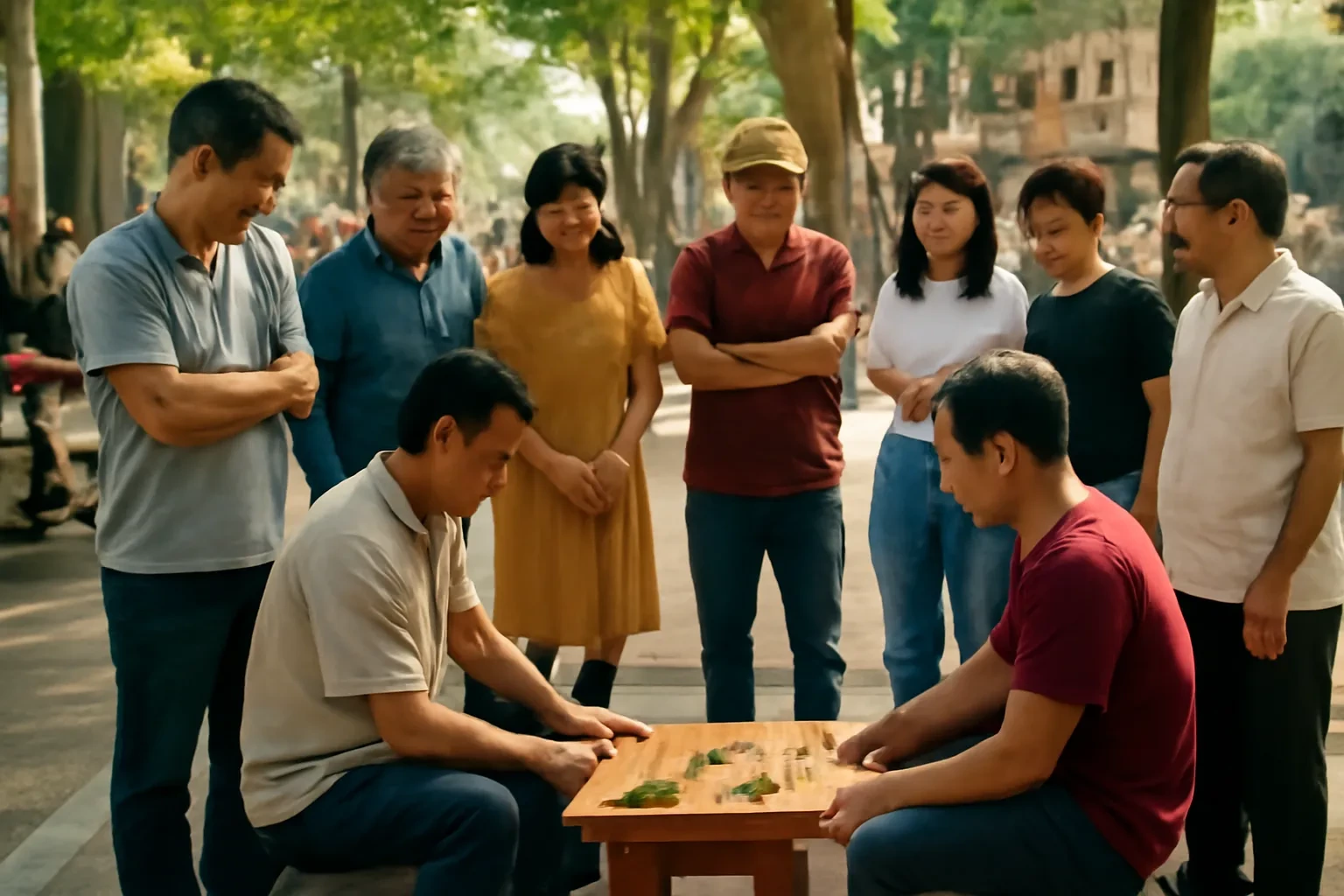
A game of cờ tướng on a Vietnamese sidewalk looks relaxed — plastic stools, tea, jokes, a crowd — and it is. But like any tradition with a long history, it has unwritten rules. Nobody will lecture a visitor for breaking them, but knowing them makes you a welcome opponent, and it helps you understand the arguments you will certainly overhear.
Once the hand leaves the piece, the move stands
The core rule of casual xiangqi everywhere is expressed in Vietnam with a Sino-Vietnamese phrase: hạ thủ bất hoàn — roughly "once the hand is lowered, there is no return". When you let go of a piece on its new point, the move is made. You cannot pick it up and try something else.
Some players are stricter: touching a piece means you must move it. Others are more relaxed in friendly games. If you are unsure, follow the strict version: decide first, then touch, then move.
Take-backs are a favour, not a right
In a friendly game between beginners, a player may ask to take a move back — đi lại — especially after an obvious slip. The opponent can allow it, but does not have to. Asking once in a while is fine; asking repeatedly is considered poor form. In a game with anything at stake, don't ask at all.
When you are much stronger than your opponent, allowing a take-back is a gracious gesture. When you are the weaker player, it is polite not to rely on it.
Onlookers stay quiet — in theory
The crowd around a Vietnamese street game is part of the charm. But in principle, onlookers should not suggest moves. A person who keeps whispering advice is teased as a quân sư quạt mo, a "strategist with a palm-leaf fan" — someone who offers strategy nobody asked for.
In practice, the crowd comments constantly: groans at mistakes, laughter at traps, exclamations when someone gives check. The line is at telling a player what to move. Reacting to what happened is part of the fun; steering the game is not.
As a visitor watching, the safest behaviour is simple: stay quiet, smile at the good moves, and don't point at the board.
Announcing check
It is customary to say "Chiếu!" — "Check!" — when you give check. It is not strictly required by the rules, but it is part of the rhythm of the game, and in casual play some people expect it. Saying it is always polite.
Resigning and winning gracefully
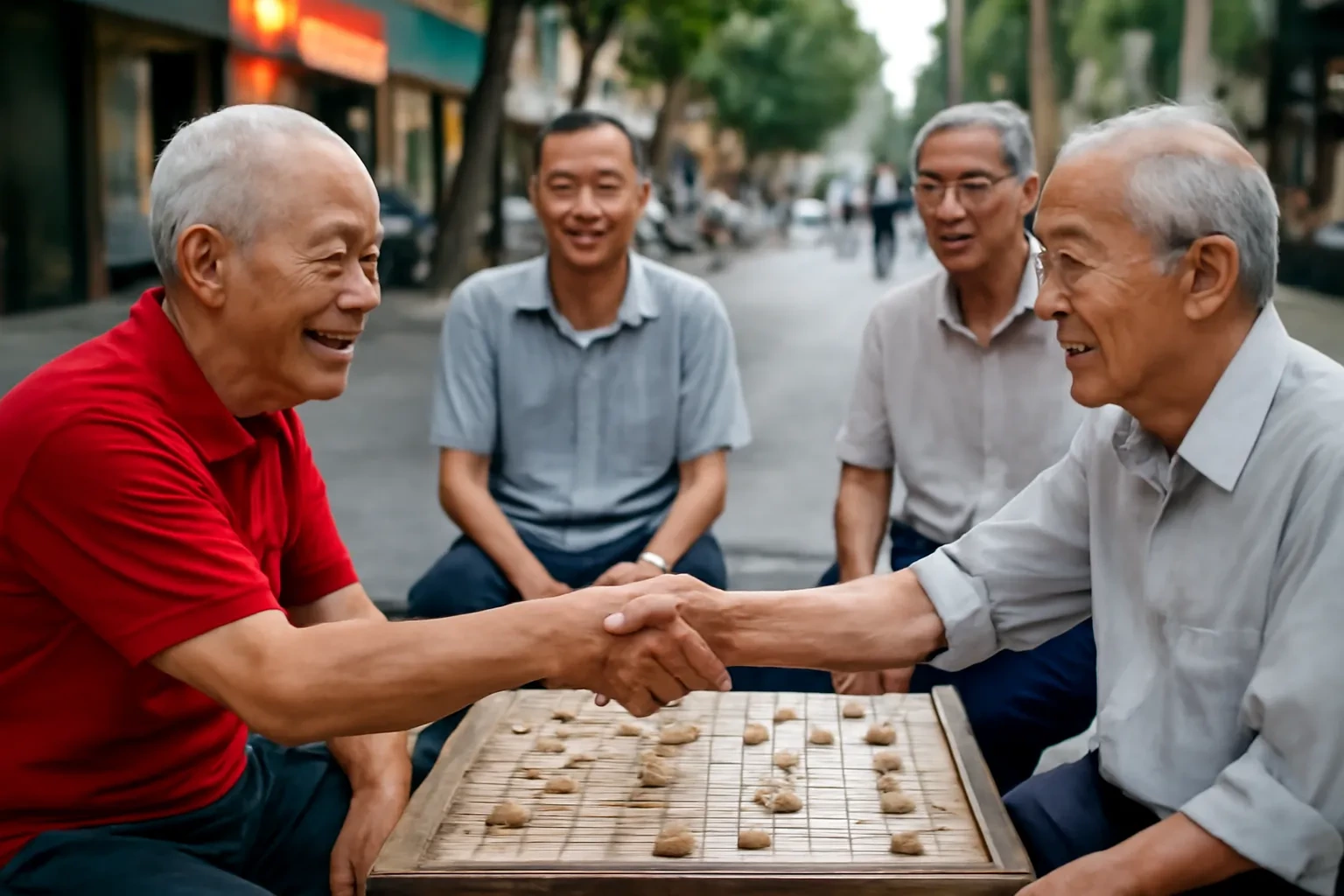
To resign, you can simply say "Thua rồi" ("I've lost") and start setting the pieces up again. A handshake or a nod is normal at the end of a game, and the loser often asks for "ván nữa" — another game.
Winners are expected to be modest. Gloating is frowned upon in any culture, and more so in a game played in public with friends and neighbours watching.
Who plays next
At a busy spot, there is often a queue of challengers. The usual custom is that the winner stays and the loser gives up the seat. If you are waiting, watch quietly and you will be invited when it is your turn. Don't try to take a seat in the middle of someone else's session.
Stakes and street problems
Most sidewalk games are played for fun. Occasionally, small stakes are involved, and on some streets you will see cờ thế — composed problems where passers-by are invited to play a set position. If a game involves money, be aware that the regulars know their positions far better than any visitor, and it is perfectly polite to decline.
Time and pace
Street games are usually played without a clock, but at a lively pace. Thinking for a long time on a simple move is gently mocked. Take your time in a truly critical moment, but in the opening, move at the rhythm of the table.
Online etiquette
The same spirit applies when you play online. On /online:
- There is no chat, by design, so all communication happens through moves.
- Offer a draw only when the position is genuinely balanced.
- Use the Leave button properly. Before both players have moved, leaving simply cancels the game. After that, leaving counts as resigning, so resign or finish the game rather than walking away.
- Offer a rematch after a good game. On this site the rematch swaps colours automatically.
See playing xiangqi online for how the online games work.
A short checklist for visitors
- Know the rules before sitting down.
- Decide before touching a piece; once you let go, the move stands.
- Say "Chiếu!" when giving check.
- Don't ask for take-backs in a serious game.
- Watch other games quietly.
- Win modestly, lose cheerfully, and ask for another game.
Etiquette at clubs and tournaments
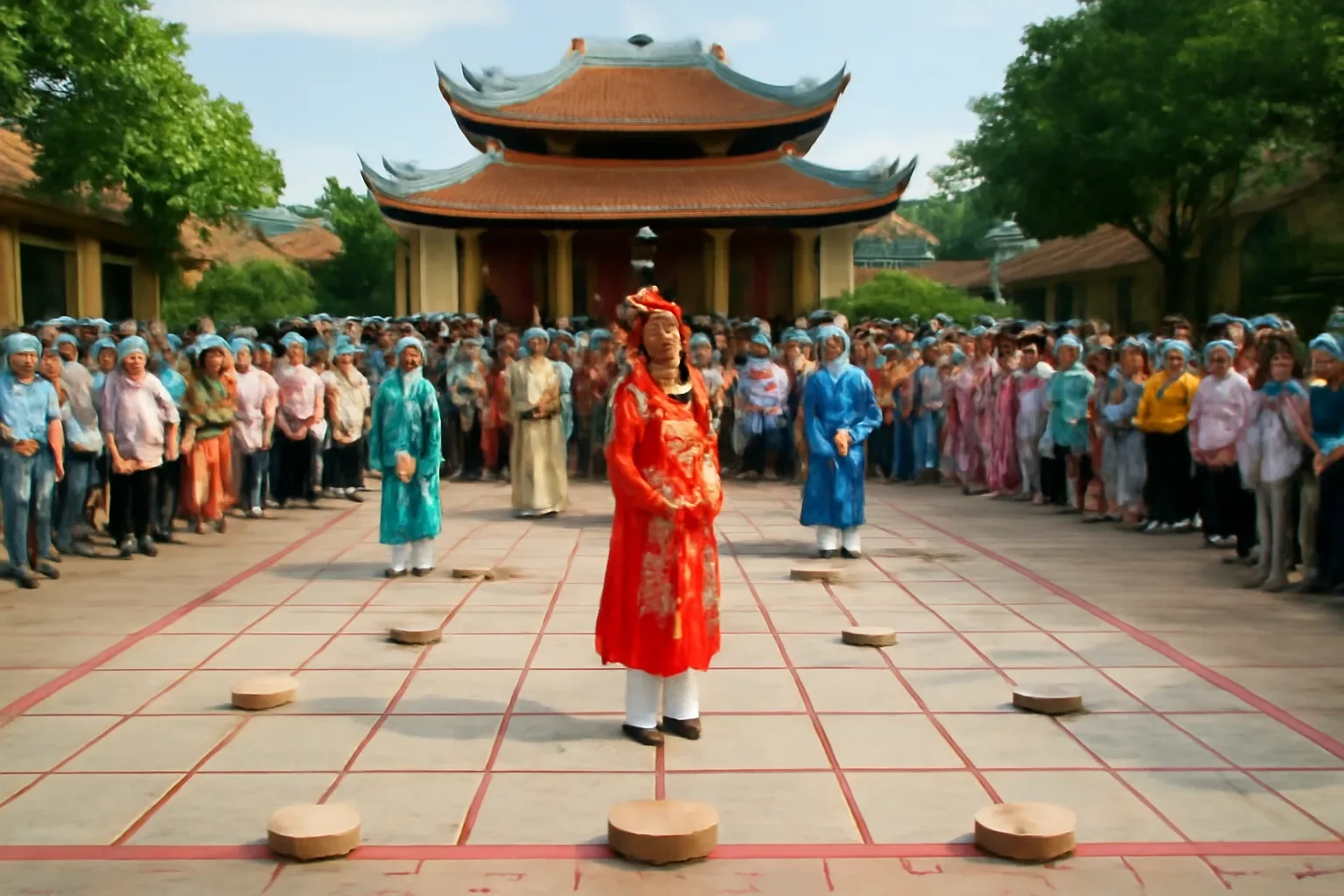
Clubs and organised events follow the same spirit with more formal rules. Clocks are used, players shake hands before and after the game, onlookers are expected to be completely silent, and arbiters decide disputes. Touch-move is applied strictly, and there are specific rules about repetition and perpetual attack. If you are invited to a club, ask how they play before your first game; clubs are usually delighted to explain.
When you are the teacher
Vietnamese players are often generous teachers, and visitors who become regulars sometimes find themselves teaching others. A few habits make you a good one:
- Let the learner make the move. Point out a danger if you like, but let them decide.
- Explain after the game, not during it. Replaying a mistake afterwards teaches more than interrupting.
- Allow take-backs freely with beginners. The strict rule is for equals; a learner needs room to experiment.
- Praise good ideas, even in lost games. Recognising a clever cannon move keeps a new player coming back.
Frequently asked questions
What does hạ thủ bất hoàn mean?
A Sino-Vietnamese phrase meaning that once your hand leaves a piece, the move cannot be taken back.
Is it rude to suggest moves as an onlooker?
Yes, in principle. Commenting on what happened is normal; telling a player what to move is not. Such onlookers are teased as quân sư quạt mo.
Do I have to say "check"?
It is customary and polite to say "Chiếu!", though the rules do not strictly require it.
Can I ask to take back a move?
In a friendly game you can ask, and your opponent may agree. Asking often is bad manners, and in serious games you should not ask.
Who plays next at a busy table?
Usually the winner stays and the loser gives up the seat to the next challenger.