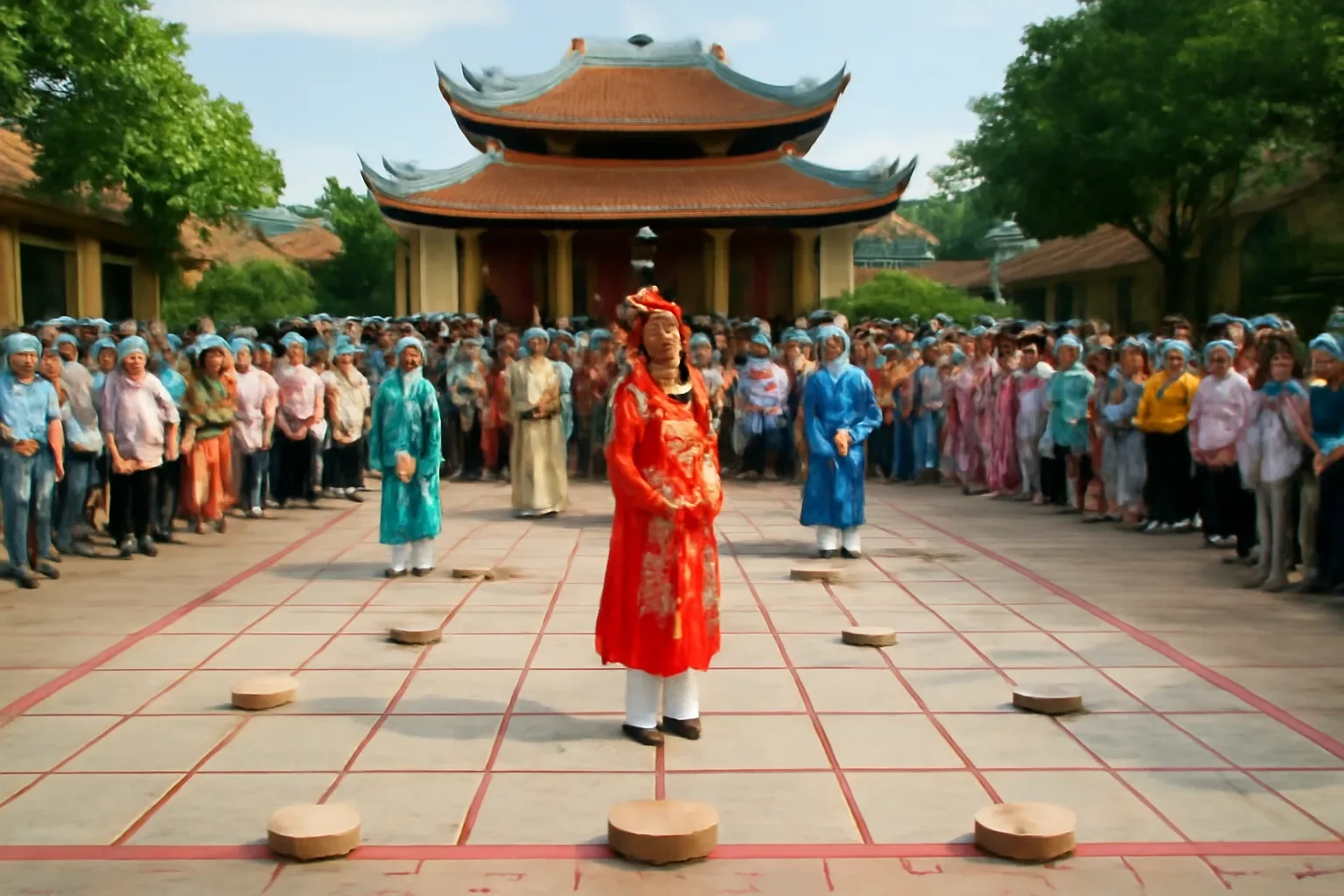
Most xiangqi in Vietnam is played on a small board on a small table. But during the spring festival season, some villages, temples and city events stage something much bigger: cờ người — "human chess" — a game of xiangqi on a giant board painted or laid out on a courtyard, with real people standing in as the pieces. It is one of the most striking ways to see how deeply the game is woven into Vietnamese tradition.
This article explains what you are looking at if you come across it, and what makes it different from an ordinary game.
What cờ người is
The idea is simple: take a normal xiangqi game and scale it up. A board of nine files and ten ranks is marked on the ground — on a temple courtyard, a village yard or a public square — with the river and the two palaces clearly visible. Thirty-two people take the places of the pieces, sixteen on each side, usually dressed in costumes in the two team colours. Each person carries a sign, flag or emblem showing which piece they represent.
Two players direct the game. They may stand at the edge of the board, sit on raised seats or call out from a stage, sending "pieces" to their new points with voice, flags or signals. Captured pieces leave the board.
Why it is played at festivals
Festivals in Vietnam often include traditional games — wrestling, tug-of-war, swinging, and board games. Xiangqi fits naturally into this tradition: it is a game of strategy and generals, associated with intelligence and good judgement, and turning it into a public spectacle makes it something the whole community can watch together.
Practices vary a great deal from place to place. Some events are elaborate ceremonies with drums, music and traditional dress; others are simpler community games. Rather than a single standard form, think of cờ người as a family of local traditions sharing one idea.
How the game itself works
The rules on the board are the ordinary rules of xiangqi. The general stays in the palace, elephants stay on their side of the river, horses can be blocked at the leg, and cannons need a screen to capture. The human scale changes the atmosphere, not the game.
A few things are different in practice:
- Pace. Moves take longer because people have to walk to their new points and the crowd has to follow.
- Visibility. It is easier for spectators to see a whole position at once on a giant board, which makes it a good way for children to understand the game.
- Ceremony. The opening moves may be accompanied by music or announcements, and the players are often introduced to the crowd.
Watching as a visitor
If you come across a cờ người game:
- Find a raised spot. From ground level, a giant board is hard to read. Steps, a balcony or the edge of a stage help.
- Identify the palaces first. They are marked by the diagonal lines. Once you find the two generals, the rest of the position makes sense.
- Watch the players, not only the pieces. The two people directing the game are usually experienced players, and their decisions are the real game.
- Be respectful. Festivals are often held at religious or community sites. Follow the crowd's lead on where to stand and when to take photos.
Learning from the giant board
Human xiangqi is a wonderful introduction for children and beginners. Seeing a chariot walk the length of a courtyard, or a horse being unable to move because a person is standing on its leg point, makes the rules concrete in a way no book can. Many Vietnamese children first get curious about cờ tướng this way.
If watching makes you want to play, you can start right away against the computer on the home board, or read xiangqi for chess players if you already know chess.
Related traditions
Human chess exists in other cultures too, including human versions of international chess in parts of Europe. The Vietnamese version is distinctive because of its setting — spring festivals, courtyards, traditional costume — and because the game being played is the one that ordinary people play on every sidewalk the rest of the year.
For more on how the game is played day to day, see xiangqi in Vietnam, Vietnamese xiangqi words and xiangqi etiquette in Vietnam.
A note on accuracy
Local festival customs change over time and differ between places, and dates vary from year to year. If you want to see a cờ người game, ask locally about festivals in the weeks after the Lunar New Year rather than relying on any fixed schedule.
Staging a small version yourself
You do not need a festival to try human xiangqi. Teachers and clubs sometimes run a small version for children, and it is easy to organise:
- Draw the board. Chalk on a schoolyard or tape on a hall floor works well. Nine vertical lines and ten horizontal ones, with a gap for the river and the X-shaped palaces at both ends. Make the spacing a big step apart.
- Make the pieces. Each child holds a card or wears a bib with the name of their piece in large letters. Red and black bibs make the two sides obvious.
- Choose two captains. They decide the moves and call them out. Everyone else walks to the called point.
- Play slowly and explain. When a horse cannot move because someone is standing on its leg point, stop and show why. When a cannon captures over a screen, walk it through.
Children who have been a horse that got blocked, or a cannon that needed a screen, remember those rules for good. After the human game, move to a real board — or to the home board — and they will recognise every idea.
Frequently asked questions
What is cờ người?
Vietnamese for "human chess": a game of xiangqi on a giant board with people standing in as the pieces, usually staged at festivals.
Are the rules different from normal xiangqi?
No. The rules are the same; only the scale and the ceremony are different.
When can I see human xiangqi in Vietnam?
Mostly during the spring festival season after the Lunar New Year. Ask locally, because customs and dates vary.
Who directs the pieces?
Two players, usually experienced ones, who call out or signal each move to the people acting as pieces.
Is it a good way to learn the game?
Yes. The giant board makes the movement rules easy to see, which is why it is popular with children.