If you play xiangqi in Vietnam, or watch Vietnamese videos about the game, you will hear the same few dozen words again and again. Learning them takes an afternoon and makes the game much more fun: you can follow a sidewalk commentary, understand what your opponent means when they announce a move, and read Vietnamese books and notation.
This glossary covers the words that come up most. Vietnamese is a tonal language, so the accents matter; if you are unsure, point at the piece and say the word, and people will understand.
The name of the game
- cờ tướng — xiangqi. Literally "the general's game".
- cờ vua — international chess, "the king's game".
- bàn cờ — the board.
- quân cờ — a piece.
- ván cờ — a game (one match).
The pieces
| Vietnamese | English | WXF letter |
|---|---|---|
| Tướng | General | K |
| Sĩ | Advisor | A |
| Tượng | Elephant | E |
| Xe | Chariot | R |
| Pháo | Cannon | C |
| Mã | Horse | H |
| Tốt (also Binh) | Soldier | P |
The two sides are Đỏ (Red) and Đen (Black). Red moves first.
Parts of the board
- sông or hà — the river.
- cung — the palace.
- chân Mã — the horse leg, the point that blocks a horse.
- mắt Tượng — the elephant eye, the point that blocks an elephant.
- ngòi — the screen a cannon jumps over.
Moves and directions
Vietnamese players call out moves in a fixed pattern: piece, file number, direction, destination. The direction words are:
- tiến (or tấn) — forward.
- thoái — backward.
- bình — sideways.
So "Pháo hai bình năm" means "cannon on file 2 moves sideways to file 5" — the classic central cannon opening, C2=5 in WXF. "Mã tám tiến bảy" is H8+7. In writing, these become P2-5 and M8.7. See Vietnamese notation vs WXF.
Other move words:
- ăn — to capture (literally "to eat").
- chiếu — check. You will hear it said out loud, often with some emphasis.
- chiếu bí or chiếu hết — checkmate.
- hết nước — no moves left (which also loses).
- thí quân — to sacrifice a piece.
- đổi quân — to trade pieces.
Opening names you will hear
- Pháo đầu — the central cannon opening (C2=5).
- bình phong Mã — the "screen horses" defence, where both horses come out in front of the elephants.
- thuận Pháo and nghịch Pháo — both sides open with central cannons, on the same side or on opposite sides.
- phi Tượng — the elephant opening, a quieter first move.
Pattern and endgame words
- sát cục — a mating attack or mating pattern.
- trùng Pháo — doubled cannons, as in the double cannon mate.
- Mã hậu Pháo — horse in front, cannon behind: the cannon behind horse mate.
- lộ mặt Tướng — the generals facing each other, the rule behind flying general mates.
- tàn cuộc — the endgame.
- khai cuộc — the opening.
- trung cuộc — the middlegame.
- tốt qua hà — a soldier that has crossed the river.
- tốt già — an "old soldier" on the last rank.
Phrases around the table
- Đến lượt anh / chị — your turn (to a man / to a woman).
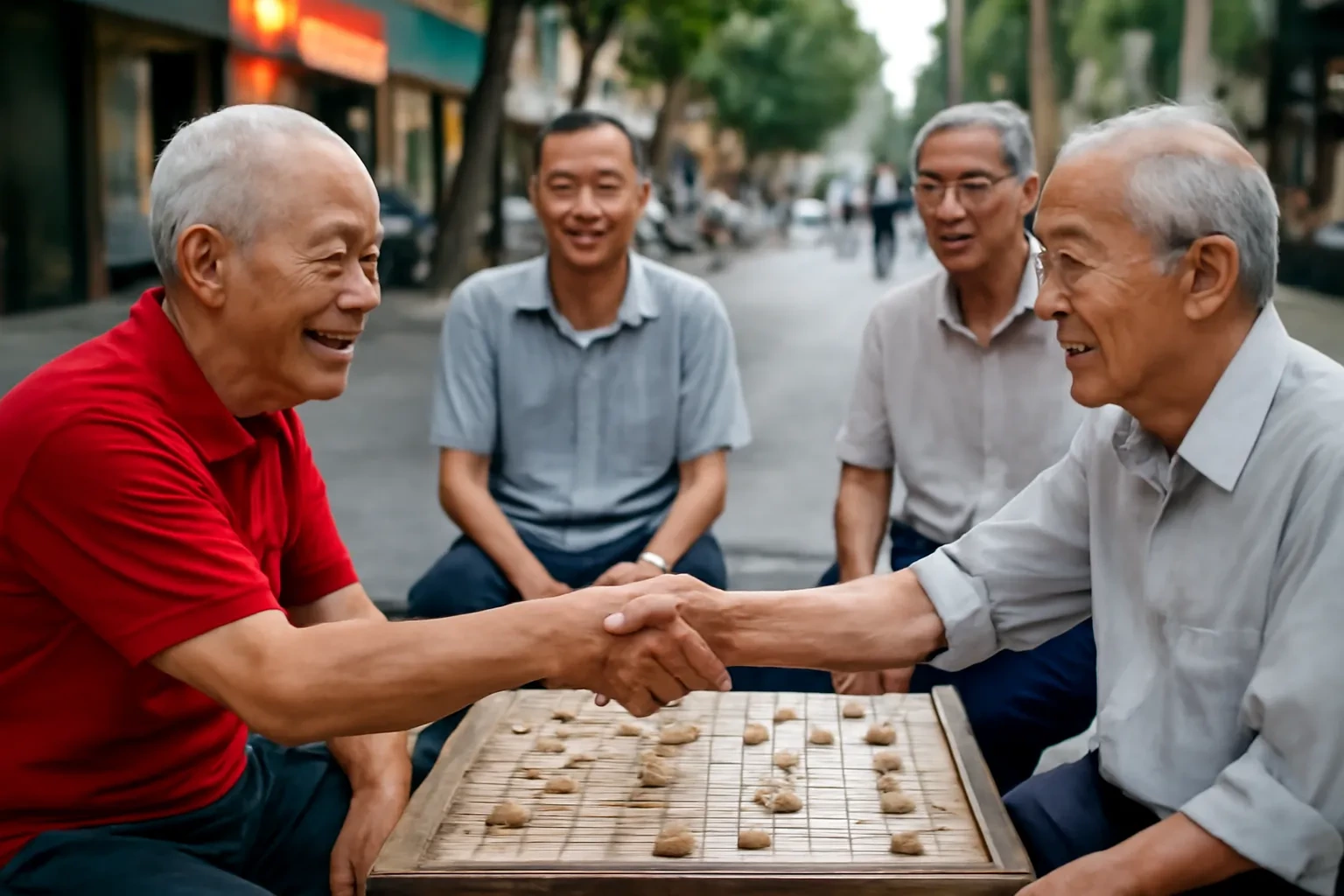
- Thua rồi — I lose / I resign.
- Hoà nhé? — draw?
- Ván nữa không? — another game?
- Hạ thủ bất hoàn — once your hand leaves the piece, the move stands. A Sino-Vietnamese phrase used to insist on no take-backs.
- Quân sư quạt mo — a teasing name for an onlooker who keeps suggesting moves. See xiangqi etiquette in Vietnam.
Tips for learning
- Learn the seven piece names first. They are enough to follow most conversations.
- Say moves out loud in Vietnamese when you play against the computer on the home board. The move list on the site uses WXF, so you can check yourself.
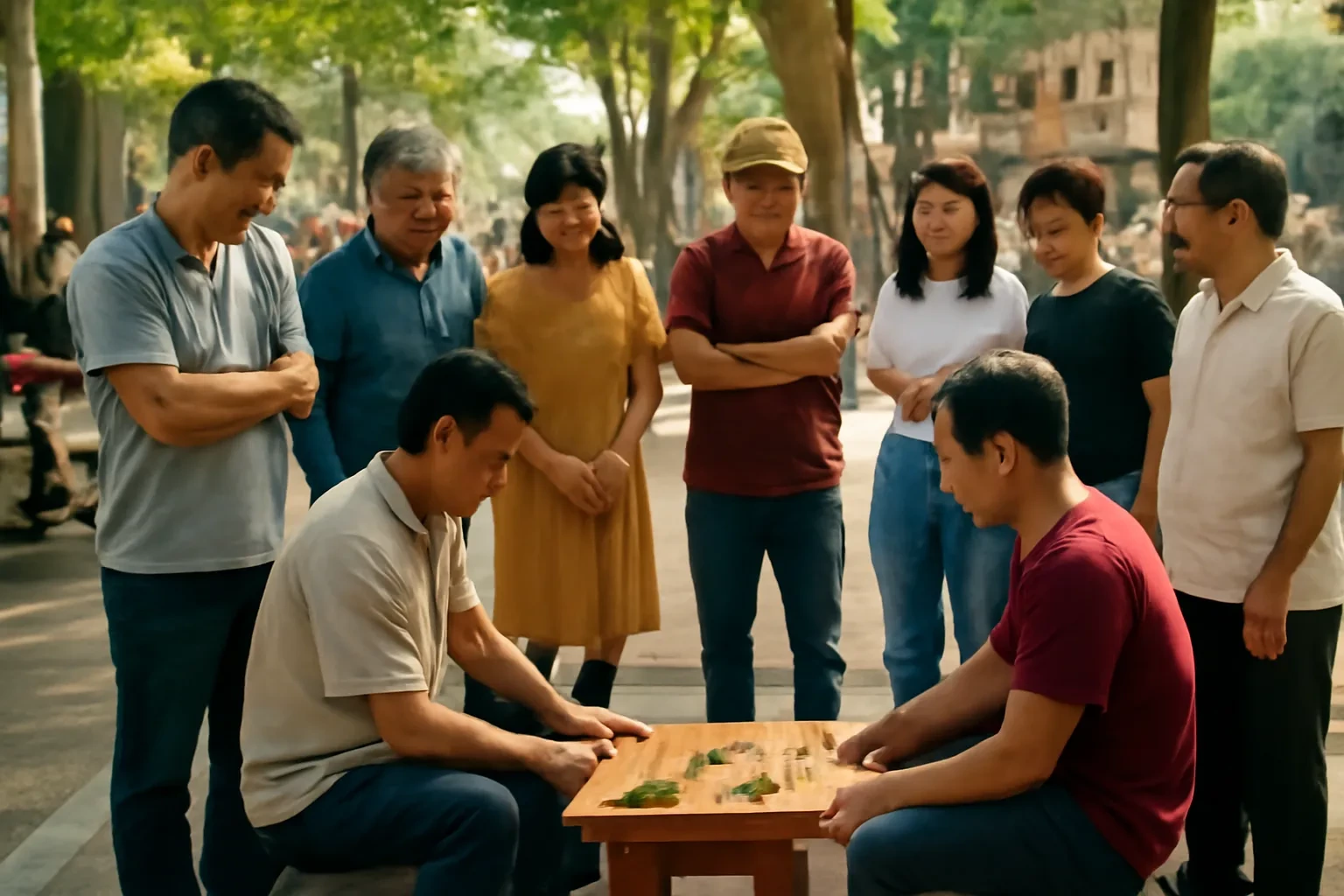
- Watch the crowd, not only the board. Most of the vocabulary above is shouted by onlookers.
Hearing a game in Vietnamese
A sidewalk game in Vietnam is rarely silent. Here is roughly what a few moves might sound like, and what they mean:
- "Pháo đầu." — "Central cannon." Red opens with C2=5, and someone names the opening.
- "Mã tám tiến bảy." — "Horse eight forward seven." Black brings out a horse, H8+7.
- "Chiếu!" — "Check!" Said out loud, often with a slap of the piece on the board.
- "Ăn Pháo." — "Takes the cannon." Someone captures.
- "Hết nước rồi." — "No moves left." The game is over, even without checkmate.
- "Ván nữa!" — "Another game!" The loser usually asks.
Onlookers add their own commentary: "Sao không đi Xe?" — "Why not move the chariot?" — is the classic backseat question.
Words for the result
- thắng — to win.
- thua — to lose.
- hoà — a draw.
- xin thua — to resign (literally "ask to lose").
- cờ hay — "good game" or "nice move", said to acknowledge a strong play.
Words for the pieces' actions
- cản chân Mã — to block the horse's leg.
- cản mắt Tượng — to block the elephant's eye.
- Pháo cần ngòi — "the cannon needs a screen", a phrase teachers say to beginners constantly.
- Xe chạy — the chariot runs, used when a chariot escapes an attack.
- bắt đôi — a fork, attacking two things at once.
Why the words are Sino-Vietnamese
Most of this vocabulary comes from Sino-Vietnamese — Vietnamese words of Chinese origin — because the game arrived in Vietnam long ago with its Chinese names. Tướng (general), Sĩ (advisor), Tượng (elephant) and Pháo (cannon) all have this origin, as do phrases like hạ thủ bất hoàn. The everyday words around them — ăn, chạy, thua — are native Vietnamese. That mix is part of what makes listening to a Vietnamese game fun.
Numbers you need for notation
Moves are called out with Vietnamese numbers, so it helps to know one to nine: một (1), hai (2), ba (3), bốn (4), năm (5), sáu (6), bảy (7), tám (8), chín (9). With these and the three direction words, you can follow any move announced at the board.
Frequently asked questions
What is the Vietnamese word for check?
Chiếu. Checkmate is chiếu bí or chiếu hết.
Why do Vietnamese players say "bình" when a piece moves sideways?
Bình is the standard direction word for a sideways move in Vietnamese notation, as tiến is for forward and thoái for backward.
Is "Tốt" or "Binh" the correct name for the soldier?
Both are used. Tốt is more common in speech; Binh appears in some books and notation.
What does Pháo đầu mean?
The central cannon opening — moving a cannon to the centre file on the first move, C2=5 in WXF.
Do I need Vietnamese to play xiangqi in Vietnam?
No. Pointing and gestures work fine. But a few words make the experience much friendlier.