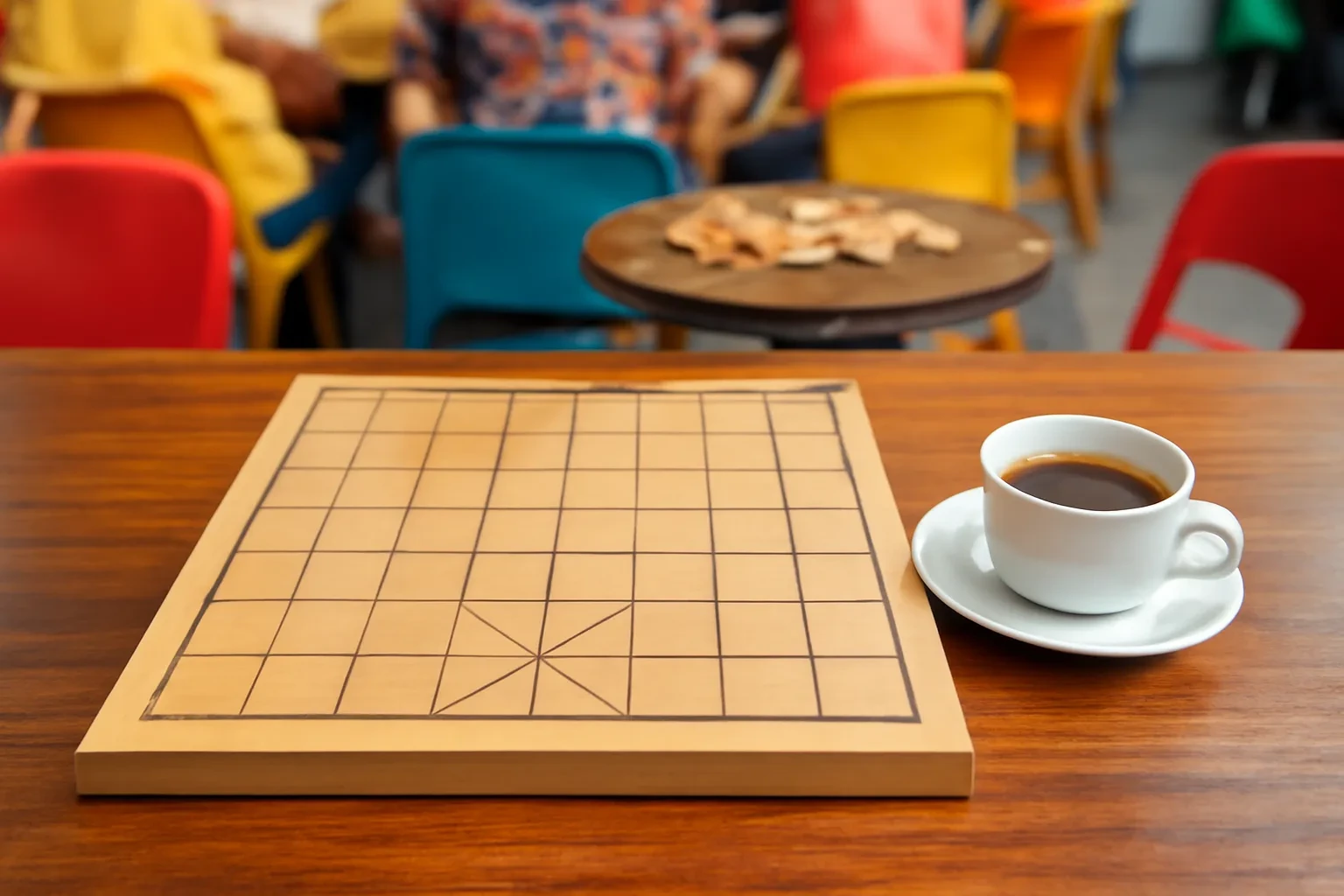
Every xiangqi piece has a rough equivalent in international chess — except one. The cannon has no counterpart at all, and it is the piece that surprises chess players most in their first games. It looks harmless, it sits behind other pieces, and then suddenly it captures something from across the board.
Once you understand one simple rule and build one simple habit, the cannon stops being a surprise and becomes one of your favourite pieces.
The rule
The cannon (C, Vietnamese Pháo) has two different ways of moving:
- When it does not capture, it moves exactly like a rook: any number of points along a rank or file, as long as nothing is in the way.
- When it captures, it must jump over exactly one piece — called the screen — and land on the enemy piece behind it. The screen can be of either colour. The points between the cannon and the screen, and between the screen and the target, must be empty.
That is all. The same rule applies to check: a cannon gives check when exactly one piece stands between it and the enemy general on a rank or file.
What this means in practice
No screen, no threat
A cannon aimed at your general with nothing in between does not check you. A chess player's instinct says "the line is open, I am in danger". In xiangqi, an open line from a cannon is harmless — until something steps into it.
One screen, real threat
With exactly one piece between the cannon and a target, the target is attacked. That piece can be yours or your opponent's.
Two screens, no threat again
With two or more pieces in between, the cannon cannot capture along that line.
The counting habit
The single best defence against the cannon is a habit: before every move, count the pieces between each enemy cannon and your general, and between each enemy cannon and your chariots.
- Zero pieces on the line: be careful about moving a piece into it, because that piece becomes a screen.
- One piece: you are attacked along that line. If it is your general, you are in check.
- Two pieces: be careful about moving one of them out of the line, because then only one remains.
This is exactly what a chess player never has to do, and it is why chess players lose pieces to cannons in their first games. After a week of counting, it becomes automatic.
Why the cannon is so strong in the opening
At the start of the game the board is full, so the cannon has screens everywhere. The most popular first move in xiangqi is C2=5, the central cannon (Vietnamese Pháo đầu): the cannon slides to the centre file, where it aims straight at the enemy general with the enemy's centre soldier as a potential screen. It immediately attacks that soldier, and it pins the defence to the centre for the rest of the game.
Two cannons on the same file are even stronger: the front cannon becomes the rear cannon's screen. See the double cannon mate.
Why the cannon gets weaker in the endgame
As pieces come off, screens disappear. A lone cannon with its general cannot even beat a bare general, because it never has a screen at the decisive moment. Keep an advisor or a soldier as a screen if you plan to rely on a cannon late in the game. See cannon endgames.
Typical cannon tactics
- The discovered attack. Move the screen away and a different piece becomes the new screen, or move a piece into the line to create a screen and attack something behind it.
- The cannon pin. If only one piece stood between an enemy cannon and your general, you would already be in check. The real danger is when two pieces stand between them: neither can leave the line, because the one that stays becomes the screen and the cannon gives check. Both pieces are pinned.
- Cannon and horse on one file. A horse in front of a cannon, both aimed at the enemy general, forms the cannon behind horse mate.
- The back-rank cannon. A cannon on the enemy back rank, with an enemy advisor or elephant as its screen, can check along the rank.
How chess players should think about the cannon
It helps to think of the cannon as a piece that attacks the second piece along each line, not the first. When you look at a line from an enemy cannon, skip the first piece you see and ask what stands behind it. That is what the cannon is really looking at.
Practise it
- Play a few games against the computer on the home board and say the counting habit out loud before every move. It feels silly for one game and then becomes natural.
- In the opening, try the central cannon as Red and watch how much pressure one piece creates.
- Replay your games from your account and mark every piece you lost to a cannon. Almost always, the counting habit would have saved it.
A worked example in words
Picture the starting position. Red plays the central cannon, C2=5. Now count along the centre file from Red's cannon upward: first comes Red's own centre soldier, then empty points, then Black's centre soldier, then empty points up to Black's general, with nothing else in the way.
- Between Red's cannon and Black's centre soldier there is one piece, Red's own soldier. So Black's centre soldier is attacked.
- Between Red's cannon and Black's general there are two pieces, the two centre soldiers. So there is no check.
If Black ignored the threat and Red captured the centre soldier, the cannon would land right in front of Black's palace with only empty points between it and the general — again no check, because there would be no screen. But the moment any piece stepped onto that file between them, it would become a screen.
That single line of counting is the whole cannon. Do it every move for a week and you will never be surprised again.
Frequently asked questions
Can a cannon capture without a screen?
No. To capture, a cannon must jump over exactly one piece. Without a screen it can only move to empty points.
Can the screen be my opponent's piece?
Yes. The screen can be any piece of either colour.
Can a cannon jump over two pieces?
No. With two or more pieces in between, the cannon cannot capture along that line.
Does a cannon give check through an empty line?
No. A cannon only checks when exactly one piece stands between it and the enemy general.
Why is the central cannon opening so popular?
Because it immediately aims at the enemy general and centre, creates threats from move one, and prepares mating patterns such as the double cannon mate.