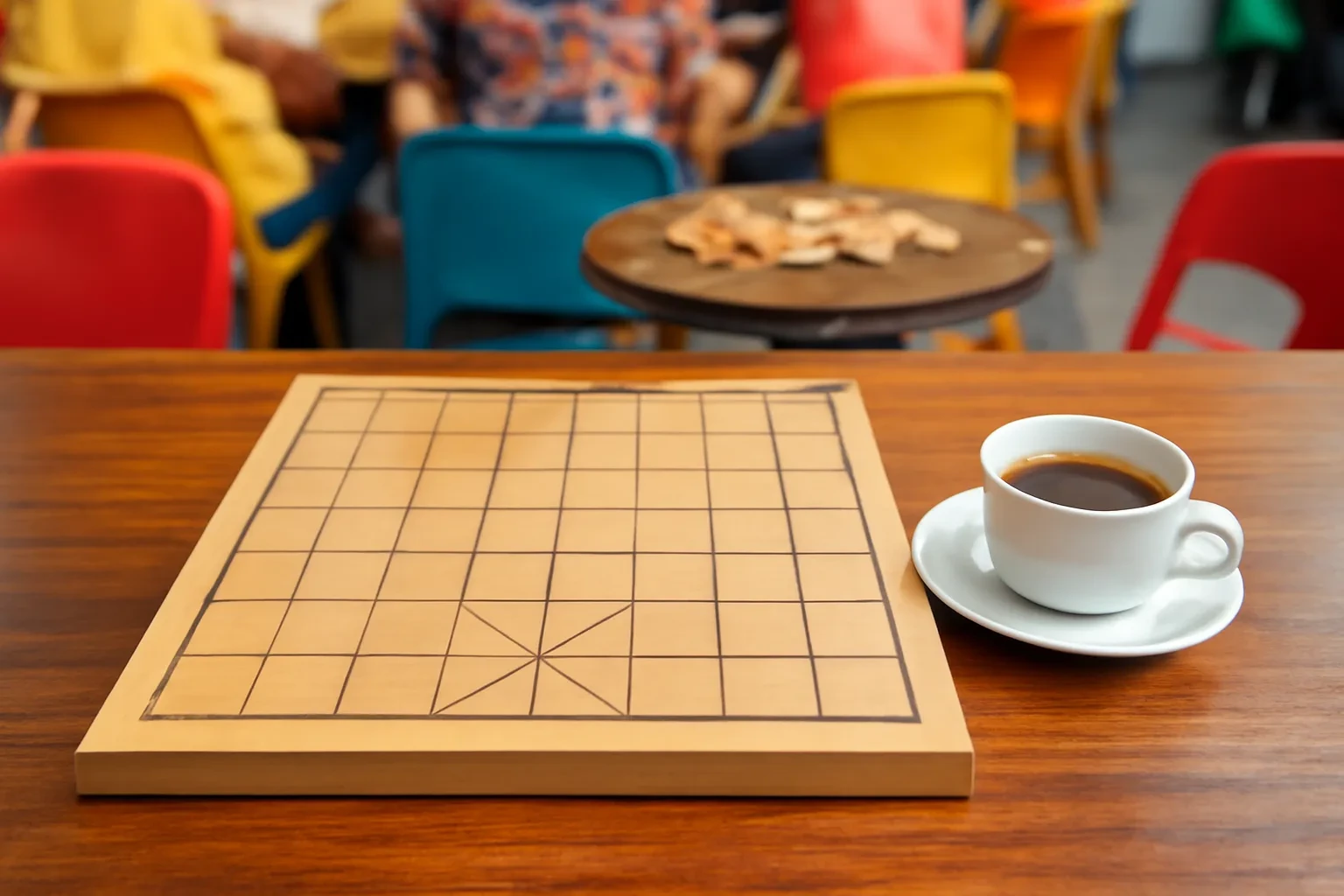
Look at a xiangqi board for the first time and two things stand out: a horizontal gap across the middle, and two squares with an X drawn in them, one at each end. The gap is the river. The squares with the X are the palaces. For a chess player these are the two most important differences on the board, because they restrict half the pieces and shape every plan in the game.
The board itself
Xiangqi pieces stand on the intersections of lines, not inside squares. There are nine vertical files and ten horizontal ranks, giving 90 points. Each side starts on its own half of the board.
Files are counted from each player's own right-hand side, 1 to 9. That is why the same file has a different number for Red and for Black — something that confuses chess players reading notation for the first time.
The river
The river is the empty band between the fifth and sixth ranks. On traditional boards it is often labelled with Chinese characters, but in terms of rules it is just a boundary line. It matters for two pieces:
Elephants cannot cross it
The elephant (E, Vietnamese Tượng) moves exactly two points diagonally, and it must stay on its own side of the river. It is a purely defensive piece. An elephant is also blocked if a piece stands on the midpoint of its move — the "elephant eye".
Because of the river, an elephant can only ever stand on seven points in the whole game. Chess players who expect it to behave like a bishop are always surprised by how little it does in attack.
Soldiers change when they cross it
The soldier (P, Vietnamese Tốt) moves one point straight forward. Before the river, that is all it can do. After crossing, it may also move one point sideways. It never moves backwards and never promotes.
So a soldier that has crossed the river triples the number of points it controls. Vietnamese players have a phrase for it — tốt qua hà, "the soldier has crossed the river" — and a crossed soldier near the enemy palace is often worth much more than a soldier at home.
Everyone else ignores it
Chariots, horses, cannons and advisors are not affected by the river at all (advisors cannot get there anyway). For those pieces the river is just two ranks like any others.
The palace
Each side has a palace: the three-by-three area of points around the middle of the back ranks, marked with two diagonal lines. It affects two pieces:
The general never leaves it
The general (K, Vietnamese Tướng) moves one point orthogonally and must stay inside its palace. It can only ever stand on nine points. It cannot run to the other side of the board as a chess king can in the endgame.
Advisors never leave it either
The advisor (A, Vietnamese Sĩ) moves one point diagonally along the palace lines. It can only ever stand on five points: the four corners of the palace and its centre.
The generals may not face each other
The two generals are never allowed to stand on the same file with nothing between them. Because each general is stuck in its palace, and the palaces face each other across the board, this rule comes up constantly: your general controls every empty point on its file up to the enemy palace. See flying general mates.
Why this matters for your play
Your king cannot escape — so defend earlier
A chess king under attack can walk away. A xiangqi general has at most four points to go to, and some of them are usually blocked by its own advisors. Mating attacks therefore succeed far more often in the middlegame than in chess. Chess players who "wait to see" often find it is already too late.
Attackers must get across the river
Your defensive pieces — advisors and elephants — cannot attack. Your attacking pieces — chariots, horses, cannons and crossed soldiers — have to reach the enemy half. Plans in xiangqi are largely about which attacking pieces cross the river, where, and when.
Defenders must stay home
The flip side: the defender's advisors and elephants are always there. They never get traded off in the course of an attack elsewhere, because they never go elsewhere. That makes the endgame very different, too: a full set of advisors and elephants can hold a draw against a single chariot. See chariot against defenders.
A quick self-test
Answer these before your next game:
- How many points can an elephant ever stand on? (Seven.)
- When does a soldier get sideways moves? (After crossing the river.)
- Can an advisor stand on the centre of the palace? (Yes — it is one of its five points.)
- Can the general step outside the palace to escape? (Never.)
- Can your general stand on the same file as the enemy general? (Only if at least one piece stands between them.)
If all five answers come instantly, the board no longer holds any surprises for you.
Practise it
- Play the computer on the home board. Tap each of your pieces to see the points it can reach — the site only shows legal moves, so you will see the river and palace limits directly.
- Read xiangqi for chess players for the full list of differences, and the cannon explained for the one piece the river and palace do not restrict at all.
How the zones shape the opening
The river and the palaces also explain why xiangqi openings look the way they do. The first moves usually bring cannons and horses into position and chariots onto open files — the pieces that can cross the river — while advisors and elephants are moved only when needed to plug a hole. Soldiers on the third and seventh files are often pushed early, both to free the horses behind them and to prepare to cross the river. Once you see the board as "my half, the river, their half", opening moves stop looking arbitrary.
Frequently asked questions
What is the river in xiangqi?
The empty band across the middle of the board. Elephants cannot cross it, and soldiers gain sideways moves after crossing it.
What is the palace?
The three-by-three area marked with an X on each side. The general and advisors must stay inside it.
Can the chariot or cannon enter the enemy palace?
Yes. Only the general and advisors are restricted to their own palace. Other pieces can go anywhere their movement allows.
Why can't elephants cross the river?
It is simply a rule of the game. It makes elephants purely defensive pieces.
Do soldiers promote when they reach the last rank?
No. Soldiers never promote. On the last rank they can only move sideways.