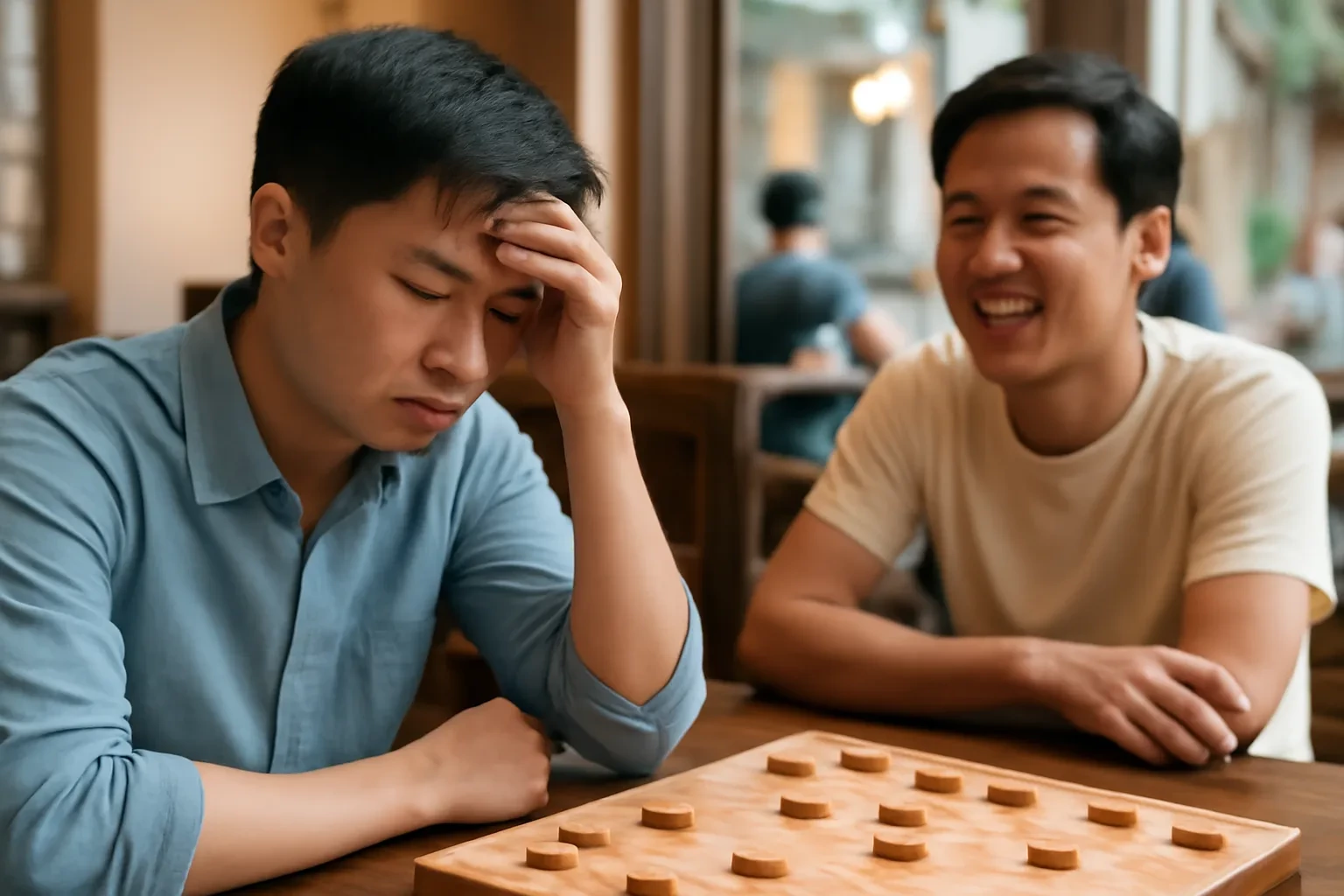
Every xiangqi player has made these mistakes. The good news is that most of them disappear quickly once you know what to look for. This list groups them into three families — rule errors, opening habits and in-game blind spots — and gives a concrete fix for each.
Family 1: Rule errors
1. Forgetting the horse's leg
The mistake: you plan a horse jump or rely on your horse to defend a point, but a piece stands on the horse's leg and the move is impossible.
The fix: before every horse move and every horse "threat", look at the point directly next to the horse in the direction of the jump. Make it a physical habit: glance at the leg, then at the destination.
2. Forgetting the elephant's eye
The mistake: you count on an elephant to defend, but a piece sits on the midpoint of its diagonal.
The fix: same routine. Midpoint first, destination second. Also remember elephants never cross the river.
3. Misjudging the cannon
The mistake: you think a cannon cannot capture because there is nothing between it and the target, or you forget that one piece in the line gives it a capture.
The fix: for every cannon on the board, count pieces in each line: zero means it cannot capture there, one means it can, two or more means it cannot. See the cannon.
4. Letting the generals face each other
The mistake: you try to move the last piece between the two generals, or try to step your general onto the enemy general's open file.
The fix: treat each general as if it attacks straight down its file. See the flying general rule.
Family 2: Opening habits
5. Leaving the chariots in the corners
The mistake: you spend the first eight moves on soldiers and cannons while both chariots stay at home.
The fix: aim to have at least one chariot out by move four or five. Move the horse in front of it first, then slide the chariot onto an open file.
6. Moving the same piece again and again
The mistake: the cannon goes forward, captures a soldier, retreats, goes forward again. Meanwhile the opponent develops everything.
The fix: in the first ten moves, prefer moving a new piece over moving an old one, unless there is a direct threat.
7. Advancing the center soldier early
The mistake: you push the center soldier, and the enemy central cannon attacks it immediately.
The fix: leave the center soldier where it is early in the game and defend it with a horse. Advance the soldiers on files 3 and 7 instead, which also frees your horses.
8. Moving advisors and elephants without purpose
The mistake: you shuffle defenders to "do something" and weaken your palace.
The fix: move a defender only to block a threat, open a line, or connect your elephants. Otherwise, develop an attacking piece.
Family 3: In-game blind spots
9. Missing the opponent's threat
The mistake: you are so focused on your own plan that you do not see the piece they just attacked.
The fix: after every opponent move, ask one question before anything else: what does this move threaten? Look at the moved piece's new lines, and at any line it opened for another piece.
10. Leaving pieces undefended
The mistake: a horse or cannon sits on a point where it can be captured for free.
The fix: before you finish your move, check each of your pieces: is it attacked, and if so, is it defended?
11. Grabbing soldiers with the chariot
The mistake: your chariot goes hunting soldiers across the river and gets trapped or falls behind while the opponent attacks.
The fix: take a soldier only if the chariot stays safe and you are not behind in development. A chariot is worth about nine soldiers — do not risk it for one.
12. Pushing a soldier to the last rank
The mistake: you march a crossed soldier all the way to the end, where it can only move sideways and does much less.
The fix: stop the soldier one or two ranks in front of the enemy palace, where it attacks palace points. See soldiers.
Why these mistakes happen
Almost every mistake on the list has the same root: looking at pieces one at a time instead of at lines and blocks. Xiangqi is a game of lines — files, ranks, cannon screens, horse legs. A beginner sees a horse; an experienced player sees the horse, its four legs and the pieces that could block them.
The cure is not reading more but playing with attention. Each game, pick one mistake from this list and watch for it specifically. After a week, pick another.
A self-check after each game
Ask yourself these four questions after every game:
- Did I lose material to a horse, cannon or chariot I did not see coming?
- Were both my chariots active by move ten?
- Did I miss a free piece the opponent left hanging?
- Did I try to make an illegal move? Which rule was it?
Write the answers down for five games. You will see a pattern, and that pattern is your personal training plan.
Practice suggestions
- Play the lowest computer level on the home page. It deliberately leaves pieces undefended now and then, which trains mistake number 10 from the other side: spotting free material.
- Replay your saved games from your account and mark the first mistake in each.
- Read how xiangqi pieces move once more after your first twenty games. Details you skipped the first time will suddenly make sense.
Bonus: the mistake behind the mistakes
If there is one habit that connects all twelve items, it is moving too fast when the position feels calm. Beginners concentrate hard when the opponent is attacking, then relax the moment things look quiet — and that is exactly when a cannon slides into a line or a horse jumps into a fork. Strong players do the opposite: they save a few seconds of attention for every quiet position, because quiet positions are where the opponent prepares surprises. Try it for one week: whenever you feel there is "nothing happening", spend ten extra seconds looking at every enemy cannon and horse. You will be surprised how often something is happening after all.
Frequently asked questions
Which mistake costs beginners the most games?
Missing cannon captures and horse forks, followed closely by leaving chariots at home.
How long do these mistakes take to disappear?
Rule errors usually vanish within a few dozen games. Opening habits take a few weeks of conscious effort. Blind spots never vanish completely — strong players make them too, just less often.
Should I study openings to avoid these mistakes?
Opening principles help with family 2. For families 1 and 3, playing with attention matters more than theory.
Is it normal to lose many games at first?
Yes. Every player starts that way. Losses are where the learning happens, especially if you review them.