Xiangqi is one of the cheapest games in the world to get good at. A set costs little, the rules are free, and the most important study methods cost nothing at all. What they do cost is attention. This guide explains the free methods that actually work and how to combine them.
1. Play — but with a purpose
Playing is the foundation. Nothing replaces the experience of making decisions under pressure. But "play a lot" is only half the advice. The other half is play with one clear focus each session: developing chariots early, spotting free pieces, avoiding cannon traps, finishing won positions.
Free places to play:
- Against the computer on the home page, at four levels, on any device.
- Against people on the online page: find an opponent at your chosen time control, or send a link to a friend.
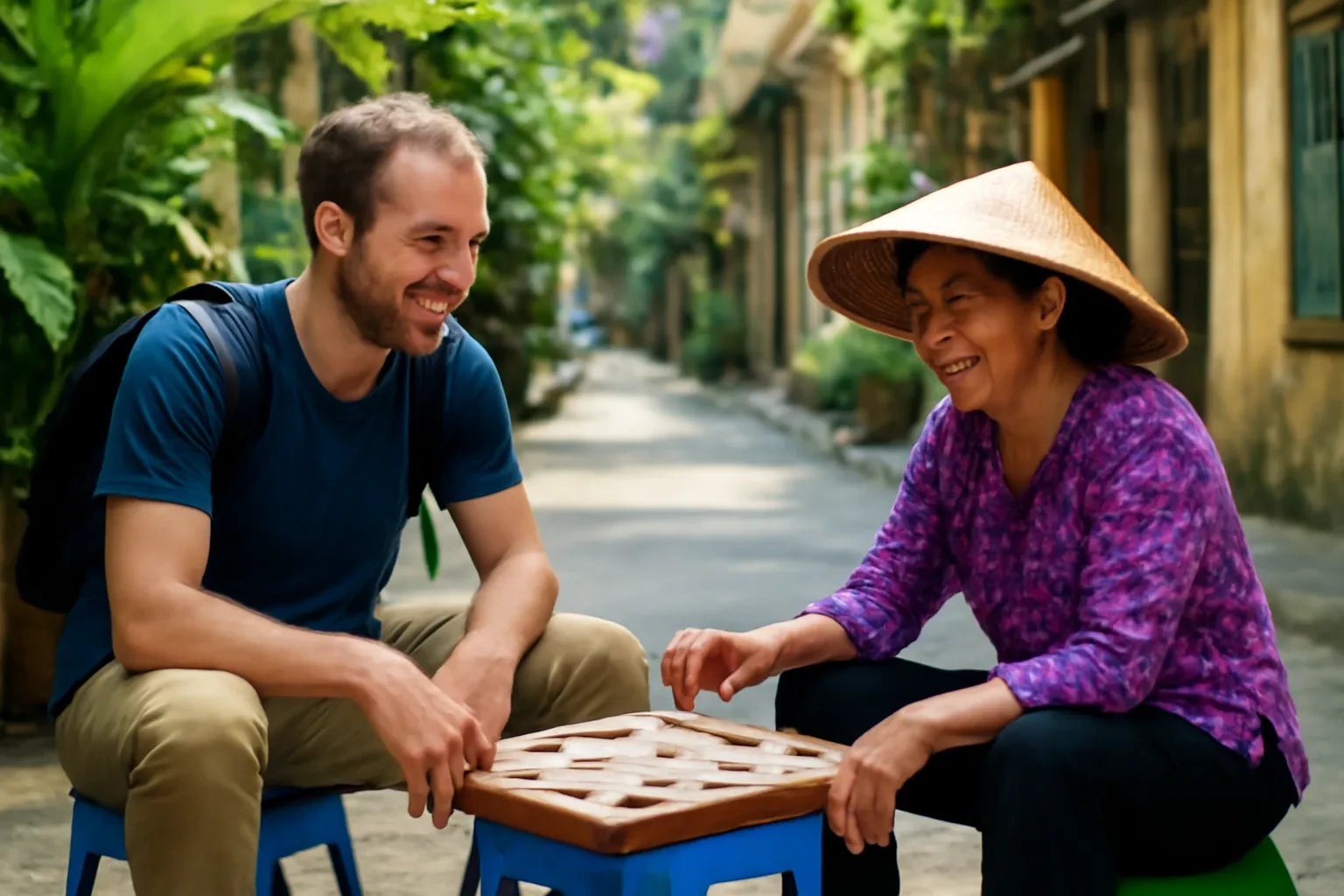
- In person: parks, cafes, community centers, especially in Vietnam and in Chinese communities worldwide.
A good mix for a learner is a few computer games for focused practice and a few human games for real-world experience each week.
2. Review your own games
Reviewing is the most underrated free study method. After a game, spend five to ten minutes on it:
- Find the turning point. The first moment material changed hands, or the first dangerous threat.
- Ask why. What did you miss? What did the opponent see that you did not?
- Find a better move. Try alternatives until you find one that holds.
- Write one sentence about what you learned.
If you play on this site while signed in to your account, your games are saved with full move lists. You step through the moves yourself, which is excellent training: finding the turning point on your own teaches more than being told.
3. Replay strong games
Replaying games of strong players — from books, collections or broadcasts you have access to — is a classic method. The trick is to replay actively:
- Cover the next move and guess it before you look.
- When the strong player's move surprises you, stop and find out why.
- Pay attention to when they bring out chariots, how they coordinate horses and cannons, and what they do when there is no tactic.
Even a single annotated game replayed carefully teaches more than ten games clicked through quickly.
4. Drill basic endgames
Endgames are the most efficient thing to study because the positions are small and the knowledge lasts forever. Set up simple endgames on a physical board or play them out against the computer:
- a chariot and your general against a bare general,
- two chariots against a general with advisors,
- a chariot against a horse with no defenders,
- a horse and a soldier against a bare general.
Practice until you can win each one quickly. The patterns will appear in your middlegame attacks too.
5. Learn the opening ideas, not the lines
Free explanations of opening principles are everywhere, including in the openings section of this site. At the beginner and intermediate level, focus on why:
- why the central cannon attacks the center soldier,
- why the Screen Horses defense protects it with horses,
- why chariots come out early,
- why the center soldier stays at home at first.
Once you understand the ideas, move orders make sense and are easy to remember.
6. Solve positions
Tactical puzzles — "Red to move and win material", "Red to move and mate" — are one of the best free training tools. You can create your own: whenever you miss a tactic in a game, set up the position and try to solve it fresh a few days later. Over time you build a personal collection of the patterns you tend to miss.
7. Find people
People are the best free resource of all:
- Local players. In Vietnam, sit near a park game and watch; after a few visits someone will offer you a game. In other countries, look for Chinese or Vietnamese community centers and cultural associations, or ask at a Chinese restaurant whether anyone plays.
- Friends and family. Teaching someone else is a powerful way to learn. Explaining the horse's leg to a friend fixes it in your own mind.
- Online friends. The invite link on the online page lets you play anyone, anywhere, without accounts.
A weekly free study plan
Here is a simple structure for an improving player:
- 3 sessions of 20–30 minutes: one game with a focus plus a short review.
- 1 session: replay one strong game actively.
- 1 session: endgame drills.
- Weekend: a slower game against a person, reviewed in detail.
That is less than three hours a week, and it covers every major area.
What to avoid
- Collecting instead of studying. Downloading hundreds of games or bookmarking dozens of pages feels productive but teaches nothing until you work through them.
- Only playing fast games. Blitz is fun but rarely teaches. Keep most games at 10 minutes or longer.
- Studying openings too deeply too early. Memorized lines break the moment the opponent deviates.
- Never reviewing. A game that is not reviewed teaches only a fraction of what it could.
How to review a game in ten minutes
Because reviewing is so central, here is a concrete ten-minute method:
- Minute 1–2: replay the game quickly from start to finish without stopping, just to remember its shape.
- Minute 3–5: go back to the first moment material changed hands or a strong threat appeared. Set up the position before that moment.
- Minute 6–8: look at the position as if it were a puzzle. What were the threats for both sides? What would you play now, calmly, with no clock?
- Minute 9–10: write one sentence: "In positions like this, I should…" and, if you keep a notebook, add the position to your personal collection of patterns to revisit.
Over a few months, those one-sentence lessons become a personal textbook — built entirely from your own games, and completely free.
Studying with a friend
Two learners studying together improve faster than either alone. Take turns showing each other a game and explaining the turning point. Set up positions from your games and challenge each other to find the best move. Play training games with a rule, such as "no chariot moves before move five", to explore unusual positions. The discussion forces both of you to put your thinking into sentences, which is where understanding really grows.
Frequently asked questions
Can I really improve without paid courses?
Yes. Many strong players developed through play, review and the help of other players. Courses can speed things up, but they are not required.
What is the single most useful free habit?
Reviewing your own games, especially losses, and finding the first mistake.
Is the computer enough as a training partner?
It is excellent for tactics and practice, but add human games to learn how people actually play.
How do I find other players outside Asia?
Try cultural associations, university clubs, Chinese or Vietnamese community centers, and online play. Invite friends with a link and teach them.